INDIA: Safari Assam — A Tea Country Safari for Rhinos, Hargila, & other Rare Species
March 7 – 17, 2026
eBird Trip Report
Kaziranga, Nameri & Manas
A Life List Podcast Event with Hillstar Nature
Photos by George Armistead
While India occupies a unique space within our mental landscape, as a place of great contrasts, conjuring images of brilliant color, earthy cuisine, and a unique cultural richness and heritage, relatively few people are as familiar with the state of Assam. Among the seven sister states of Northeast India, it is not necessarily easy to get to, and certainly the current state of global chaos made it all the more complex for our particular journey.
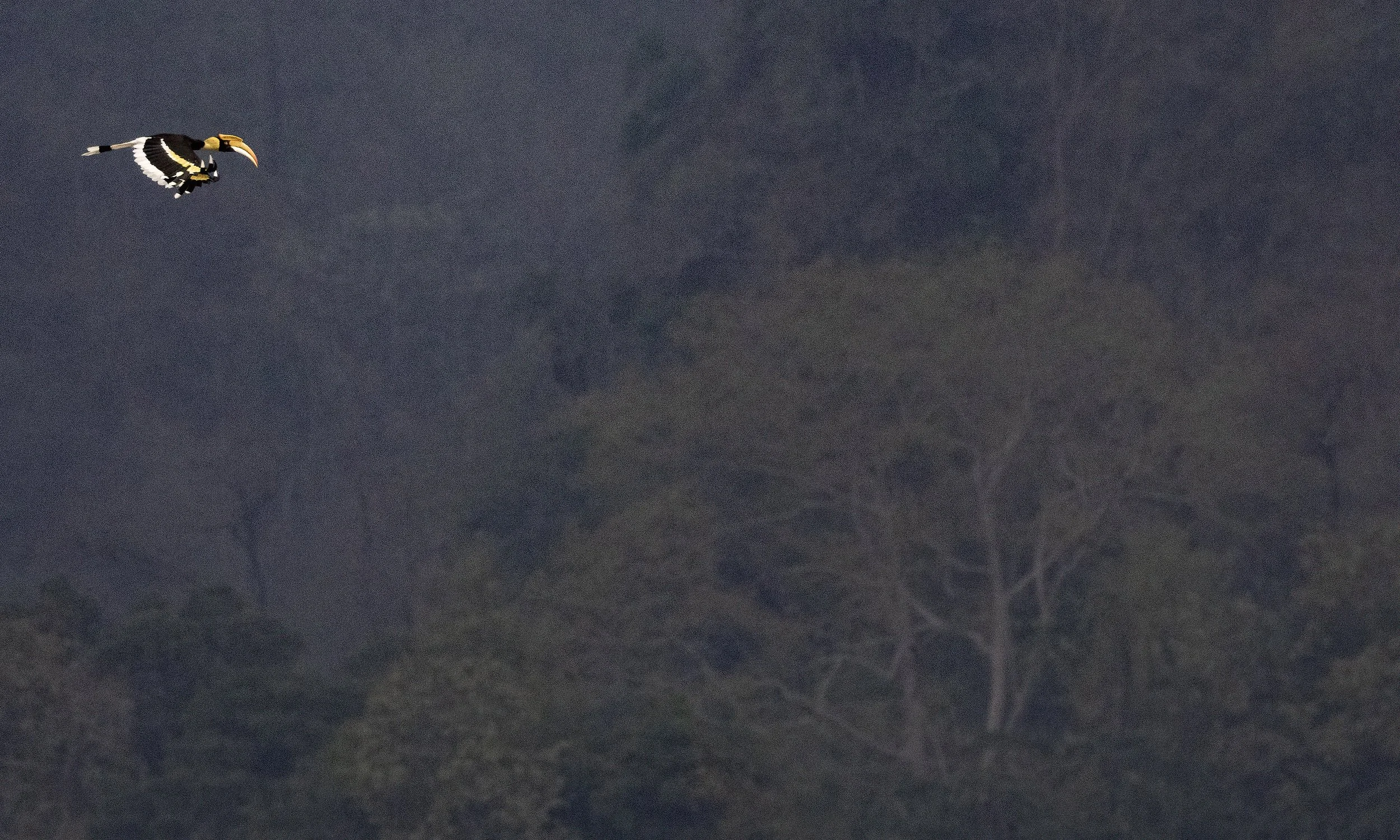
Great Hornbill in flight over Bhutan. The state bird of Kerala and for Arunachal Pradesh, some individuals have lived close to 50 years old in captivity.
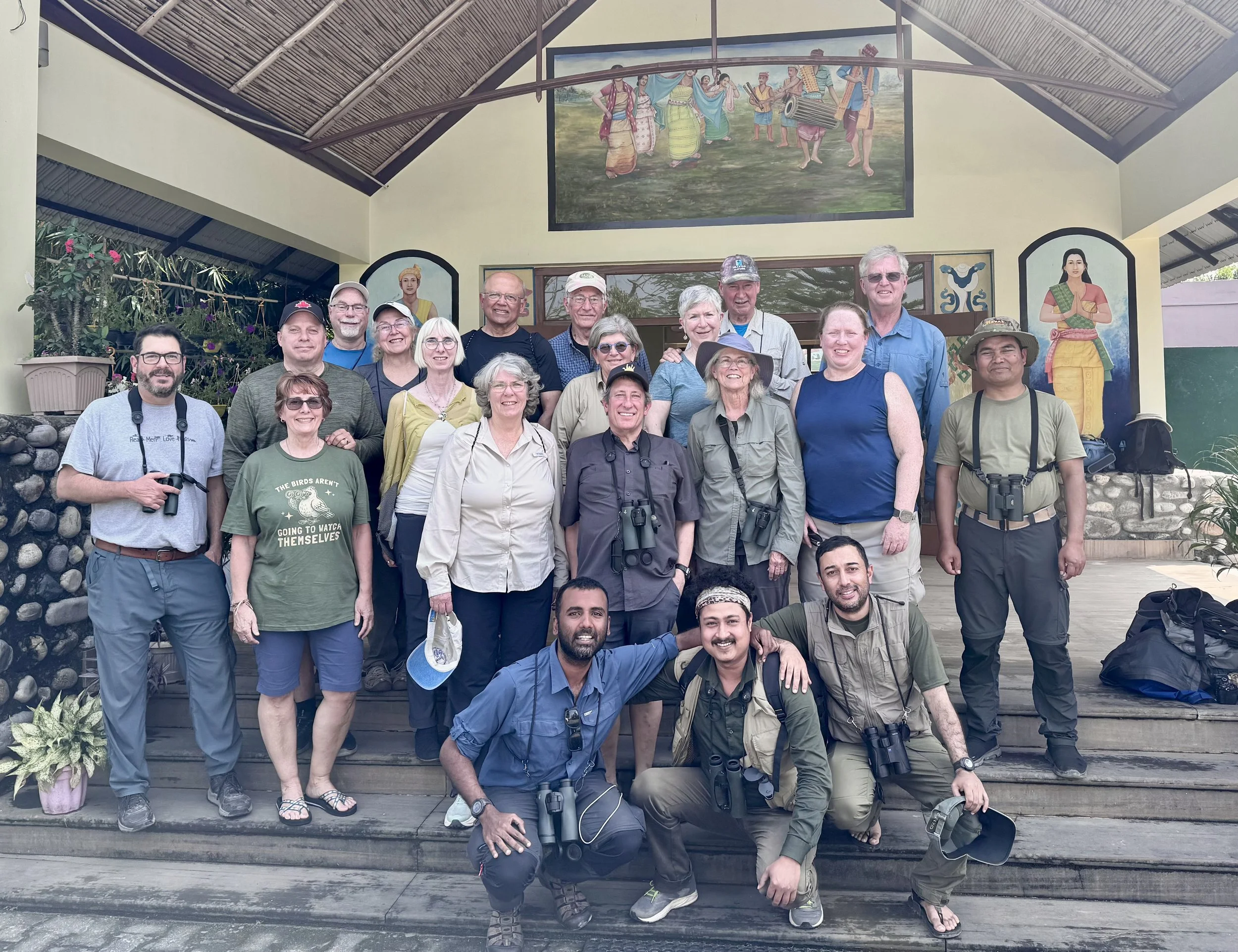
Regardless, an intrepid group of 18 of us met up and set off from Delhi, and after a flight that provided views of Mount Everest, we touched down in the capital city of Guwahati. We were notably without a couple of friends we’d wished to have with us, including Michele who was stuck in Dubai and Mollee who ended up having an ordeal of an experience in the Middle East, before finally having to go back to the US, arriving there the day the tour began. The rest of us made it into Guwahati, where we promptly grabbed a couple bottles of booze, enjoyed a nice buffet lunch, while failing to identify a familiar Hollywood actor. Then we moved on, driving several hours to what some argue is the crown jewel of India India’s national park system, Kaziranga.
A UNESCO world heritage site, known for its abundant wildlife, it consists of a mix of grassland, marshland, and humid broadleaf forest with several rivers crossing its boundaries, including the mighty Brahmaputra River. A massive river, the ninth largest in the world in terms of discharge, we would more or less remain in the valley of the Brahmaputra for the duration of our time in Assam. The park is named for a mythological couple, a boy named Kazi and a girl named Rawnga, who when their couplehood was not accepted by their families, disappeared into the forest never to be seen again. But the park today is most famous as the home to the Indian Rhinoceros, and hosts 2/3 of the world‘s population. In 1908 the population in the park was down to 12 individuals, and the global population was down to about 100. Through considerable conservation efforts, today their numbers are back up over 4000 globally. That 2/3 are at this single site continues to present a risk to the species. The Assam Trunk Road is the major arterial for vehicular traffic into and out of the area, and it is possible to see rhinos right from the main road, and we enjoyed our first individuals as we entered the park on our first afternoon.
With four nights in the area we had ample opportunity to enjoy many, many sightings of dozens of rhinos, including one memorable, small youngster (perhaps just 2-3 months old), that appeared to have the “zoomies” much like a puppy dog. It was absurdly cute. It melted the hearts of all of us and became one of the top moments of the whole trip.
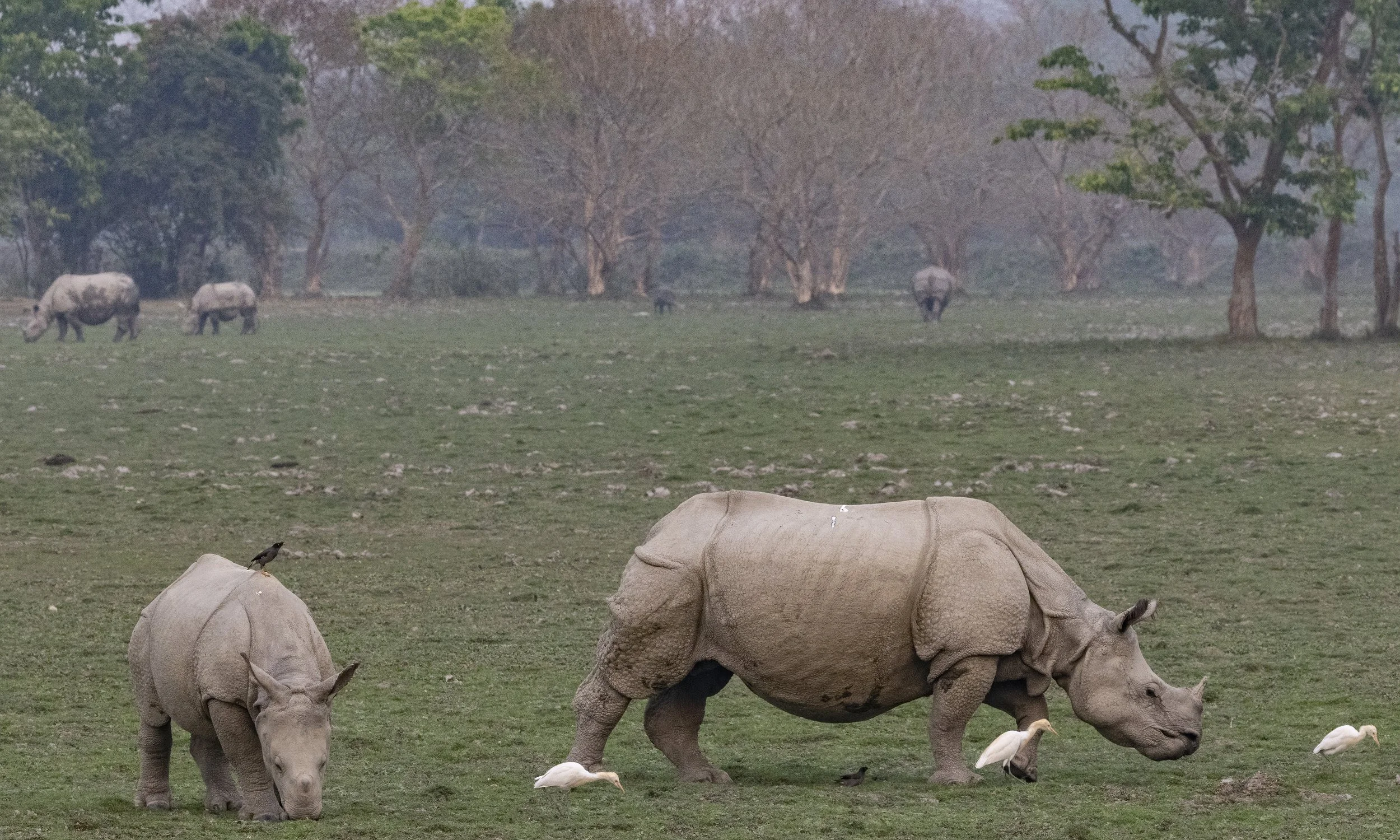
The Indian Rhino sports a a single horn. With a total population over 4000 now, in the early 1900s they were down to less than 100 individuals, and down to just 12 at Kaziranga. Today, the park host 70% of the population.
Rhinos are a big deal at Kaziranga, and they are fascinating and fun animals, but it is really just one aspect of a myriad. The amount of wildlife is staggering. Like any government run park it has its problems and challenges, but it’s impossible not to be impressed by the sheer number of large mammals and the diversity of birds. We saw many elephants each day, as well as Wild Water Buffalo (endangered), three species of deer, and even a porcupine. One afternoon we visited the remarkable Hollongapar Gibbon Sanctuary. There we were able to see not only the charming Hoolock Gibbons for which the sanctuary is named, but the dapper Capped Langur & also Pig-tailed and Stump-tailed macaques. The latter also known as the Bear Macaque for its shape & appearance, differs from other macaques in being a relatively more peaceful animal that has a variety of reconciliation tactics for resolving conflict within their rather large groups. The group that we encountered, we felt very lucky to see, as we found them just before we had to leave. There were about 35 individuals foraging herd-like along the forest floor, moving through the forest in search of fruit, desirable plant matter, and other tasty tidbits. Several of them paused on the trail right in front of us where we were able to appreciate their uniqueness at length. With all the Rhesus Macaques roadside in route, we would end up seeing a remarkable five species of primates this day. Of note also, was the butterfly activity at this site. We were amazed to see such variety and color of leps!
While on Safari in Kaziranga our group split up into smaller groups of four or five usually, and a couple of our jeeps barely missed seeing a King Cobra go down into a hole beneath the road. That would’ve been a thrill, indeed. A couple of our gang did get to see not one, but actually two Bengal Tigers, including the famous golden tiger of Kaziranga, which is a unique individual lacking black stripes. All of us were satisfied to enjoy close encounters with Tokay Geckos, and a couple different monitor lizards, including a large Asian Water Monitor, perhaps 5 feet in length.
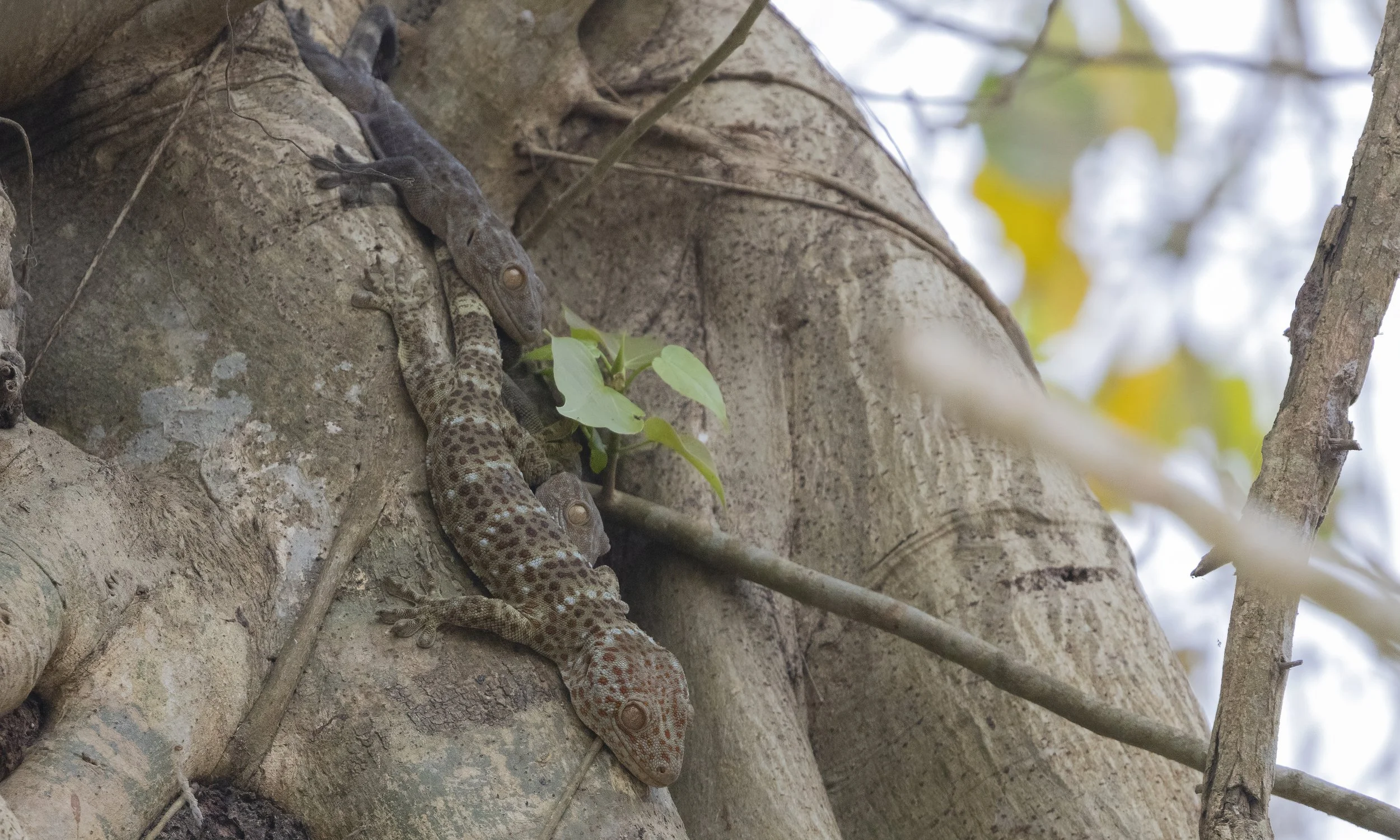
Tokay Gecko is the third-largest species of gecko. U.S. soldiers during the Vietnam War, came to know this species by a different name.🤐
The herps & iconic mammals are a big part of visiting Kaziranga, but there are tons of birds as well. The wetland areas host good numbers of waterfowl and shorebirds, while the wooded areas feature forest birds aplenty. Continuously one hears bulbuls and barbets, and near dawn & dusk the chorus becomes more complex & varied. The wetlands and ponds and lakes were dotted with waterfowl, including hundreds of Bar-headed Geese, and dozens of Northern Shovelers, Eurasian Wigeon, Northern Pintail, Green-winged Teal, and Indian Spot-billed Ducks. Highlight birds included Swamp Francolin, an active nest with 2 young of Pallas’s Fish-Eagle, and a location where we were able to see a stunning array of 5 stork species simultaneously, including, Asian Openbill, Asian Wooly-necked Stork, the handsome Black-necked Stork, and both Lesser and Greater adjutants. The latter is an endangered species and was one of the main targets of the trip. Today found mostly in Assam or in Cambodia, we enjoyed watching a couple Greater Adjutants, or Hargila, as they are known locally, drop into an open grassland and feed with a host of other birds. And, later we added sightings of Black Stork, so that we had a total of six species of stork for the cumulative trip list.
Eventually, it was time for us to move on to the second park of the trip, Nameri National Park. One of the top eBird hotspots in the country, and here the forest birds are really supposed to shine. Unfortunately, the sun did not do the same for most of our time here, which provide provided some challenges. Our first afternoon actually went shockingly well, considering the amount of rain forecast. We endeavored a rafting trip, to float down the Kameng River, locally known here as Jia Bharoli. This ended up being a real highlight of the trip. It’s hard to put into words the feeling of floating down a bubbling, white water river so peacefully with every new bend and twist revealing new birds and new scenery. It was also so quiet and removed from the hustle and bustle of the road. Driving almost anywhere in India is an experience one never forgets, and indeed the road is a feast for the eyes. Buzzing with color and animals and vehicular traffic, which might strike us as reckless driving & endangerment in the United States, here is simply part of the flow of people going about their daily business. After one surrenders to it, you realize people know what they’re doing. But it can be a bit exhausting. After a couple hours on the road, and bouncing around in Safari jeeps, the gentle glide along the river was a welcome change. And the photo opps were pretty good too. Hundreds of Small Pratincoles, could be seen hunting for bugs aerially, or resting on the stony shores of the riverbank. For a bird that is entirely clay-brown, the silkiness of their plumage, their cute faces with big black doe eyes, along with their long, tapered wings, make them pretty irresistible. Additionally, Ruddy Shellducks, so often an afterthought as we are birding, were in nice soft light here against the rocky shoreline, and suddenly glowed brick orange in a whole new way. Kingfishers featured along our float trip, as did a smattering of herons, including the newly split Little Heron. And there were a few redstarts, namely, Hodgson‘s and White-capped, and a Himalayan Buzzard also attracted our attention. After three hours, floating about 9 miles, we headed for our lodge tucked into a nice little patch of forest. And then, the rains really began to hit.
The following morning we were up and out the door by 5:30am, and the rain had stopped for the time being. We had about an hour drive back to the river, which we would need to cross before beginning our forest walk in search of a number of Woodland species. But just before we got to the river, I was surprised to spot a roadkill Banded Krait. Such a shame to see this beautiful snake dead on the road. But we had a little time to fret, and we loaded up into the wooden canoes to cross the river again and begin our morning long walk. We gathered up on the other side of the river and walked about a fifth of a mile into the forest where there was a ranger station and thankfully a small open air hut, because nearly as soon as we reached this spot, the thunder and rain picked up, and soon lightning joined them.
We sat in the hut, made conversation and entertained each other for about an hour until the rain let up a little bit, and eventually decided that we would endeavor a hike, through the drizzle, to at least attempt to see the critically endangered White winged duck. This is a species for which there are less than 800 individuals. Hunting and habitat destruction have conspired against the species, which needs swampy forest to live. Thankfully Nameri National Park has a bit of that habitat. We made our way to the known location for this bird, knowing that it is not always present and that in the rain, it could well be tucked away someplace where it would be invisible. But after about 30 minutes of walking we arrived and as chance had it, a pair of the ducks were clearly in view! We felt so lucky to be able to commune with these birds and enjoy lengthy views of them in a serene, if soggy, setting here in this wonderful wilderness. After soaking up some nice views, we left the ducks to their business and headed back. We got back to the hut to join a couple of our colleagues who had opted out of making the hike to discover that they had picked up Wedge-tailed Green Pigeon, and to discover that the rest of us had picked up quite a few leeches! After a few minutes of searching each other and picking off leeches, we headed for the boats, crossed the river, and were back at the hotel in time for lunch. We dried out, and enjoyed a nice siesta after a very tasty lunch, and listened to the Rhesus Macaques banging about outside our bungalows, until the rain let up at about 4 PM. Then we decided to do a walk around the botanic reserve where the hotel was situated. Birding was slow at first, but soon we realized that there was a dramatic termite hatch/emergence underway, and the other wildlife was taking notice! The macaques leapt and jumped to snatch them and throw them into their mouth, while the Large Hawk-Cuckoos and Hair-crested Drongos hawked the termites high in the air. Dusk fell and a Brown Boobook jumped out, treating us to spectacular views as it got in on the action. This would end up being one of the most cherished sightings of the trip. The day felt like a week’s worth of spectacular events and memories.
White-winged Duck digiscope Video by Surya Ramachandran. Critically endangered with perhaps only 400-150 individuals remaining in the wild, this is also the state bird of Assam. See the White-winged Duck Recovery Project.
After a long travel day, featuring more rain, we made our way to our last national park back to the west, extremely close to the Bhutan border, Manas National Park. This too is a UNESCO world heritage site, and well known as a place for rhinos, elephants, and even Bengal Tigers, but is also an important site for the critically endangered Pygmy Hog, and the critically endangered Bengal Florican. While the hog is virtually impossible to see as they are largely nocturnal and park access at night is nearly impossible to achieve, the florican is active here in March. This was one of the main motivations for visiting Manas, in addition to seeing the diverse birdlife.
Our first morning at Manas was one for the books. Straight away, gamebirds were an obvious feature with the national bird, the Indian Peafowl conspicuous, both visually and aurally. The same was true for the notorious and comical Red Junglefowl. Adding a touch of class were the Khalij Pheasants strutting about the forest. The rain had led up this morning and the birds were active. As we moved through the western part of the park, there were birds chock a block the whole way. Between us, we had eight species of doves, raptors that included Black Eagle, Crested Goshawk, Mountain Hawk-Eagle, Collared Falconet, and Asian Barred Owlet. We enjoyed spectacular encounters with Great Hornbill, Sultan Tit, and a nice mix of babblers and laughingthrushes with a few showy old world flycatchers to boot. This would prove our most species diverse morning with our group collectively tallying well over 100 species between dawn and lunch.
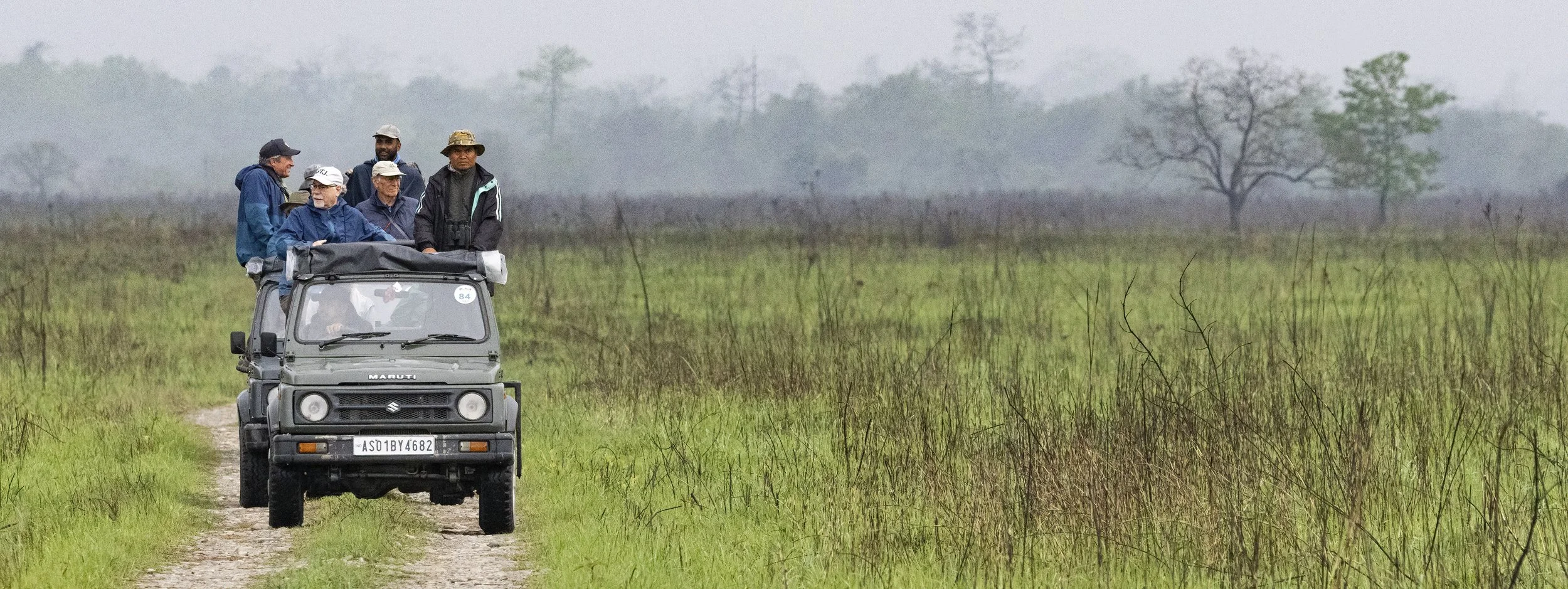
On Safari in Manas, we cruised the grasslands in search of the Bengal Florican with success! We saw 3 males and, shockingly a female. Females are very rare to see due to their more retiring habits. Current population estimates land at fewer than 900 individuals. See the Bengal Florican Project for how you can help.
Our second day at Manas, we divided the day between a morning visit to the grassland areas of the national park and an afternoon visit to see the endangered Gee’s Golden Langur. The grassland birding in Manas proved challenging, but it started off with a bang when we quickly located the big bird of the trip, the Bengal Florican. We found three males striding through the grasslands and a few of us got to see one male display, briefly a couple of times. Later we even got to see a female. Females are extremely difficult to see, as they are much more retiring by nature, usually remaining well within taller grasslands where there are very hard to see. Our local guides were absolutely thrilled at seeing the female, in particular. There are only about 800 individuals remaining of this bird in the world, so this and the White-winged Duck may be the rarest birds several of us have ever seen. After lunch, most of us headed to the Golden Langur spot to learn about the ongoing remarkable conservation story. With extraordinary efforts by one local and with the support of several small communities, these animals are hanging on and with time one hopes might even prosper. Found only here and in adjacent Bhutan, it is an endangered species with less than 6000 individuals in total, despite being revered as sacred.
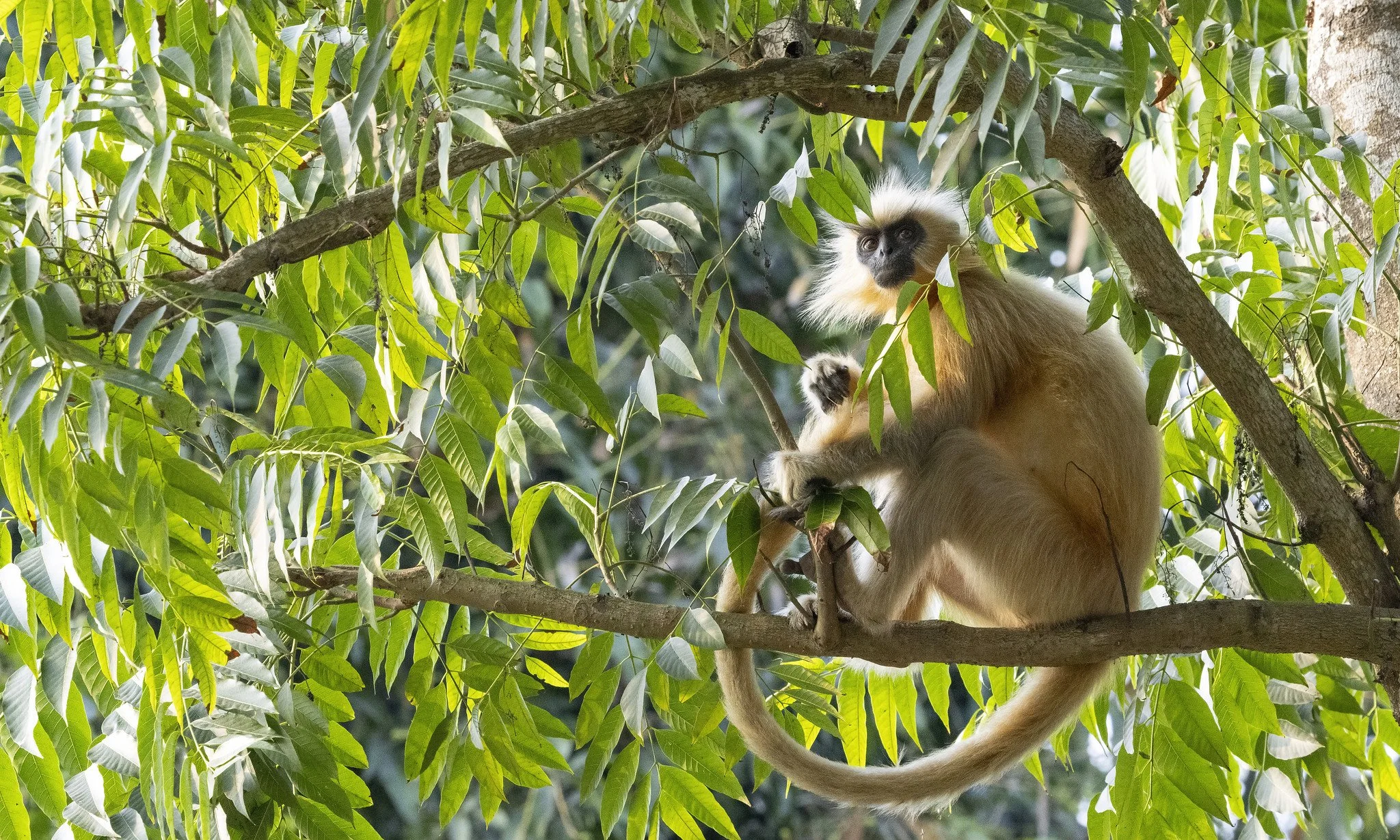
Among the most handsome and endangered of all primates, the Gee's Golden Langur is found only in Bhutan and India, and due to conservation efforts is on the uptick.
We finished up with our farewell, dinner toasting some great birds and animals, some good times and some unseasonably, wet weather, but it all made for an incredible array of memories with a superb gang of great people. Thanks to the fantastic friends who joined and made this adventure possible.
See more pictorial highlights from here: Safari Assam 2026 Highlights