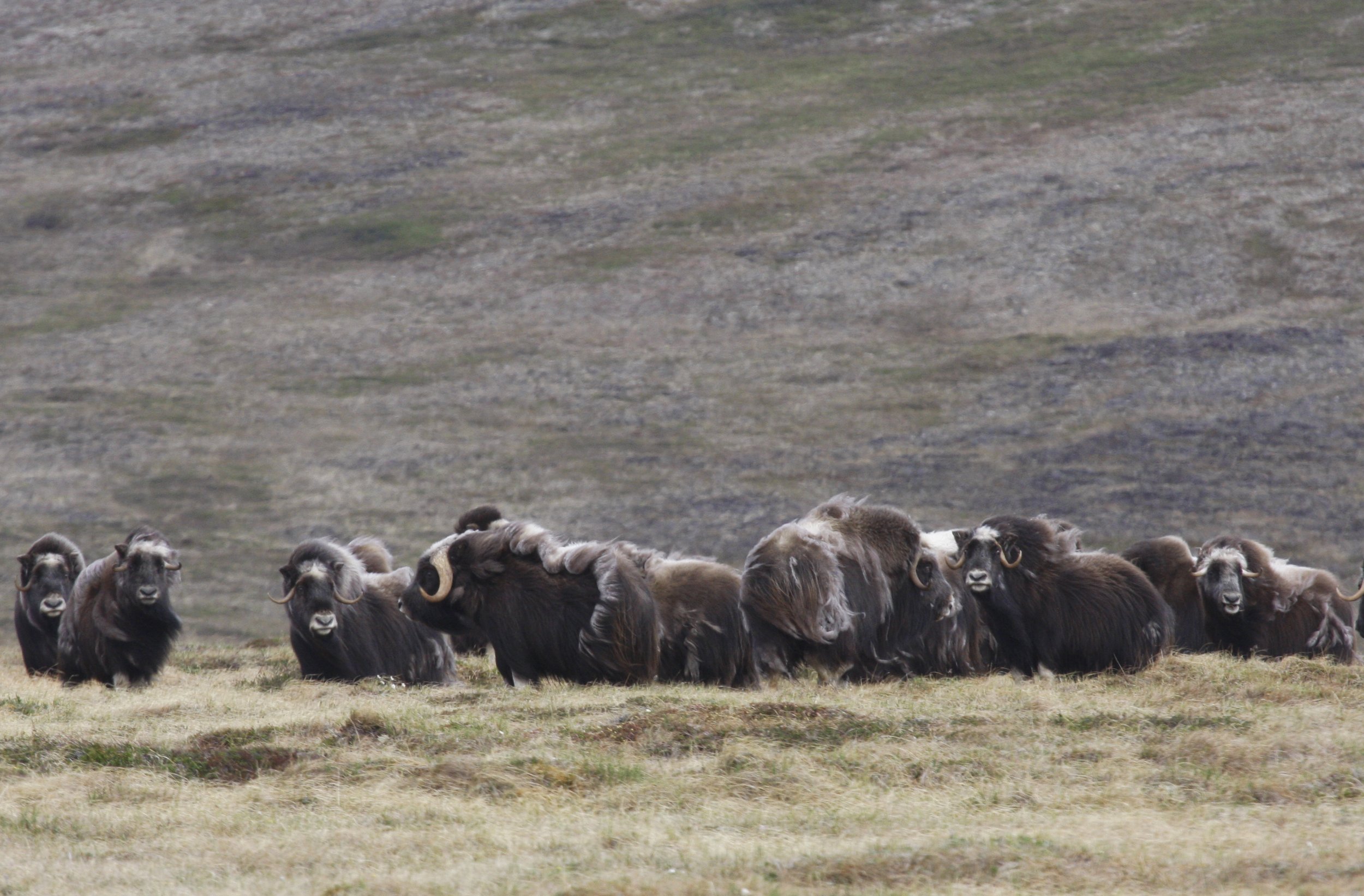
St. Paul Island is a unique birding destination, home to the Red-legged Kittiwake, nesting seabirds, and a couple of endemic taxa too.
On remote St. Paul Island, the steep and winding cliff faces hold nesting Red-legged Kittiwakes, Red-faced Cormorants, and thousands of alcids (auks) including Least, Parakeet, and Crested Auklets, as well as Horned and Tufted Puffins. It also offers a chance at scarce or rare visitors from Asia, adding an element of ‘jackpot birding’ to each day. Visit a tremendous marine wilderness and see the Bering Sea at its best.

Itinerary
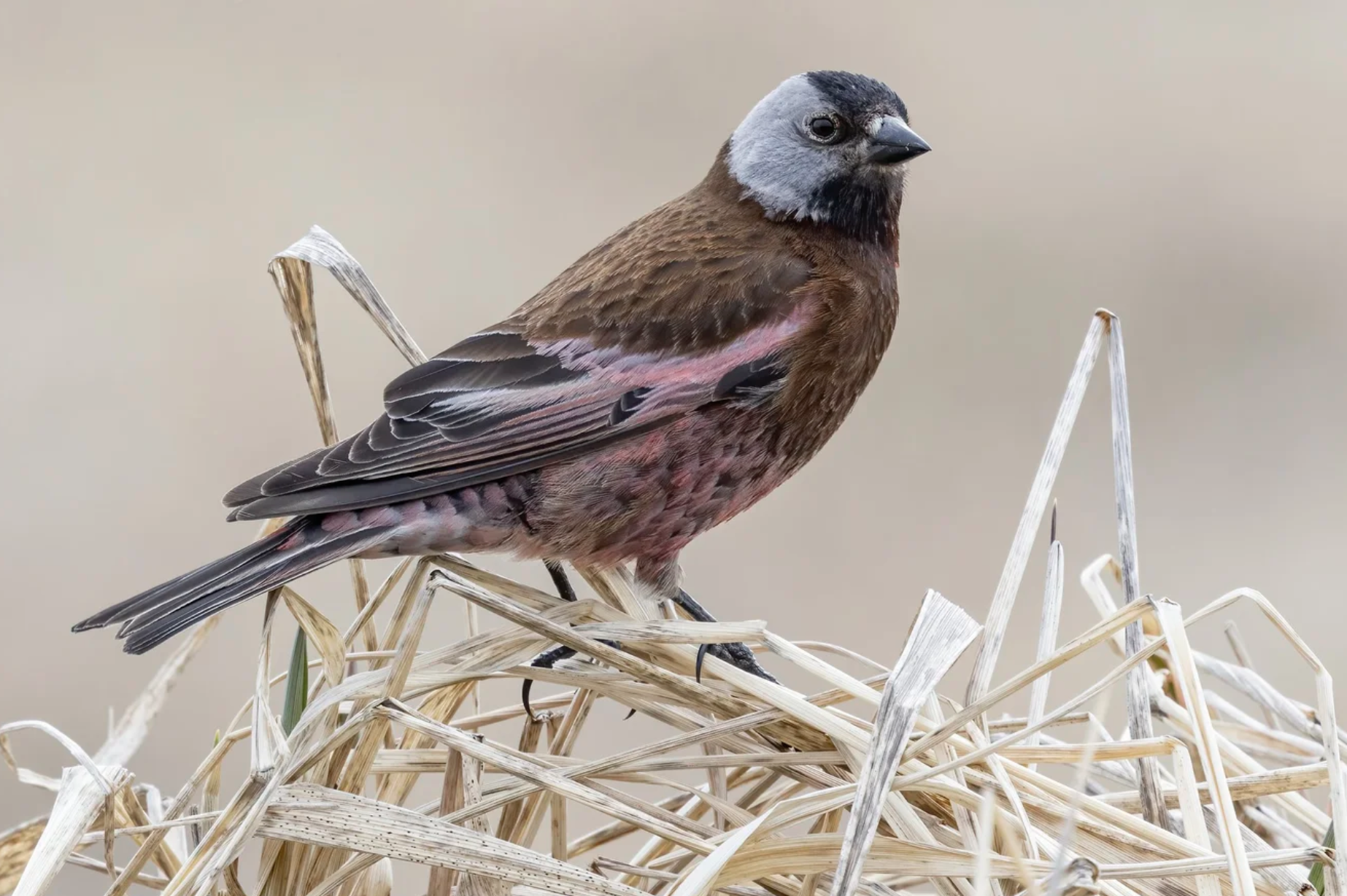
Day 1: Arrival into Anchorage.
Upon collecting your luggage in ANC, call the Coast Inn and request they send the shuttle. They should scoop you up within 20 minutes. We’ll enjoy a welcome dinner and prepare for our flight to St. Paul Island.
Day 2: Flight to St. Paul Island.
Today we plan to depart from Anchorage to fly to the archipelago of the Pribilof Islands, landing in St. Paul Island. We can arrange a pre-tour hotel night for you if you wish, but the group’s official first meeting is at the gate for our flight to St. Paul Island.
Smack in the middle of the Bering Sea, the Pribilofs are volcanic islands providing cliff faces for nesting seabirds with nearby rich waters nearby, from which these birds provision their nestlings. The same waters provide sustenance for the large (albeit declining) colony of Northern Fur Seals here. These are at times joined by the endangered Steller’s Sea Lion. Weather is a factor always in Alaska, but typically upon departing from Anchorage, our flight should reach the island after about 4 hours of flying time, touching down sometime mid-late afternoon.
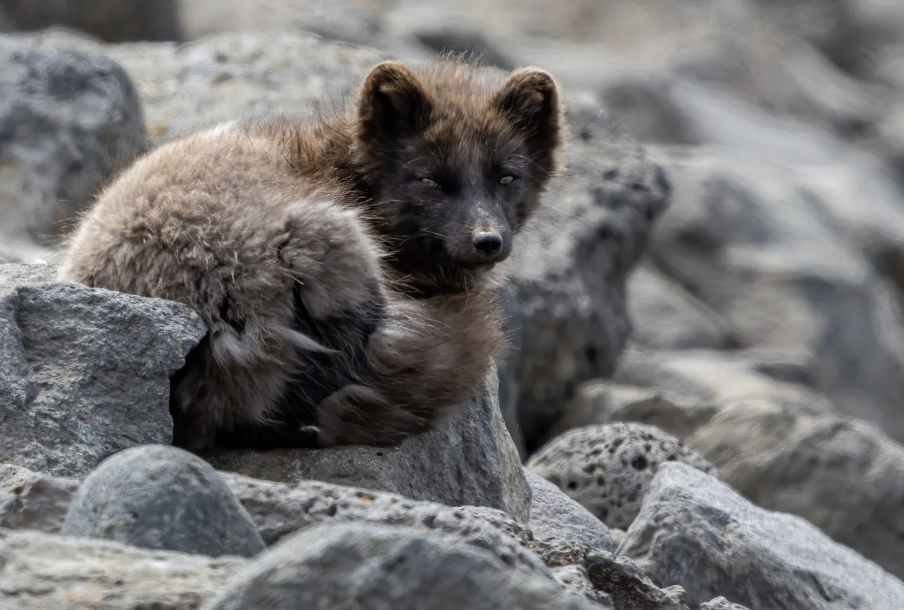
Day 3 & 4: Exploring the Pribilofs/St. Paul Island.
Though it looks just a speck of land on the map, we have some 42 square miles to cover as we seek our target birds here on St. Paul. Much of the island is accessible by two-track or gravel roads, and we’ll have vehicles by which to explore this amazing place. Well known hotspots include the salt lagoon right in the town of St. Paul, Ridge Wall and the other sea cliffs, the quarry, Northeast Point, Reef Point, and there are a series of lakes and ponds that dot the southern and eastern side of the island. We’ll see what the weather serves up and plot a plan based in part on that, and also in part on what is being seen around the island. Reliably, the rocky shores are good for seeing large numbers of Least Auklets, while the cliffs provide nesting areas for other auks like Parakeet Auklet, Crested Auklet, the two murres, and the two puffins, along with Red-faced Cormorants, and the real speciality of St. Paul, the Red-legged Kittiwake. Though ranging through much of the Bering Sea, over 75% of the population breeds here in the Pribilofs, and this unique, large-eyed, stout-billed gull is seldom seen elsewhere by birders. Between enjoying the cliff-nesting birds we’ll check ponds and ravines for migrant and vagrants and see what we can turn up here, at the top eBird hotspot in Alaska. Night at the King Eider Hotel on St. Paul Island.
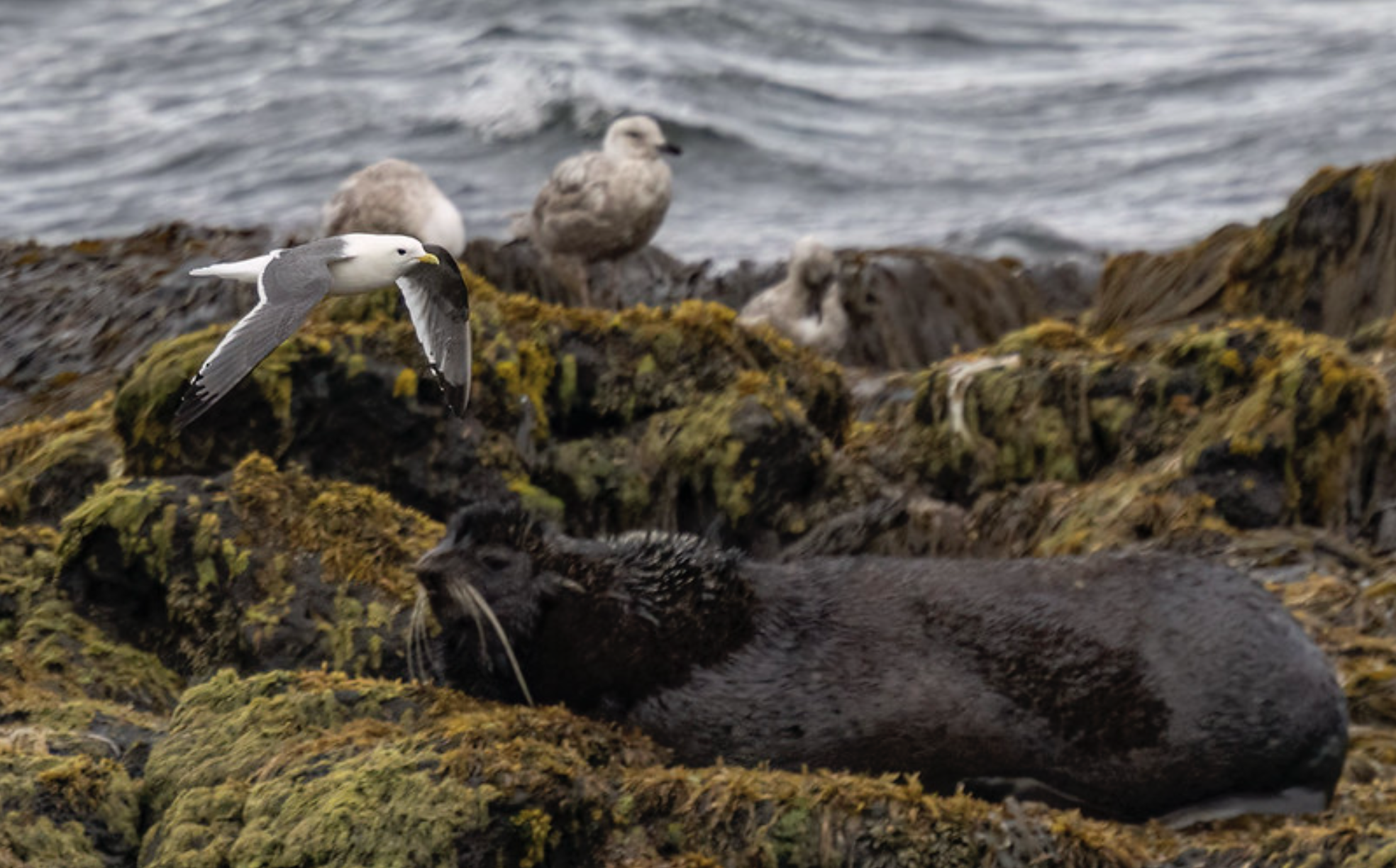
A Red-legged Kittiwake glides past a Northern Fur Seal and a few Glaucous-winged Gulls along the shores of St. Paul.
Day 5: Return to Anchorage.
We’ll enjoy a final morning out in the field trying to mop up any last birds we might like to see, and then we are headed back to Anchorage. Once we arrive into Anchorage (ANC) our adventure together is over, and we bid each other farewell.
PRICE & BOOKING INFO
Tour Price/person*: $6385/person
Deposit: $1000
Single supplement: $860
Final Payment Due: January 29, 2026, or at registration if after.
Group size: 5 to 12 guests
BE SURE TO PURCHASE TRAVEL INSURANCE. IF THE TRIP IS CANCELLED due to weather conditions, complications with the airline, or other reasons, it may be impossible to recover a portion or any of your tour fee. For this reason, Hillstar Nature strongly recommends all guests purchase travel insurance that covers Trip Cancellation, Trip Curtailment, Trip Interruption, and Emergency Medical and Medical Evacuation.
The tour price (fee) includes services from upon arrival on Day 1 into Anchorage (ANC) until our return to Anchorage on Day 5, including:
· All meals from dinner on Day 1 through lunch on Day 5.
· Accommodations for Day 1, Day 2, Day 3 & Day 4. Tour finishes upon arrival back into ANC on Day 5.
· All transport for Day 1 through our return flight to ANC on Day 5.
· All guiding services, access permits and entrance fees to birding areas.
· Roundtrip flight to/from St. Paul Island.
Excluded from your tour fee are:
· Arrival flight to and departure flights from Anchorage (ANC) and your home destination.
· Alcoholic beverages, laundry services, charges to your hotel room, or other items of a personal nature.
· Visa fees, airport taxes, airline baggage fees, etc.
Documents
All non-U.S. citizens should have a current passport, valid for six months beyond the start date of this tour, with at least 1 blank page for stamps.
ALL GUESTS/REGISTRANTS MUST:
· Review Travel Documents. For international travel, guests must have a current passport valid for six months beyond the end date of this tour, with at least 1 blank page for stamps.
· Review COVID-19 and other health requirements required to travel into or around the destination.
· Review Hillstar Nature’s Code of Conduct.
· Consider obtaining travel and medical insurance to cover incidents over the duration of this tour. (Strongly recommended).
· Sign the Hillstar Nature Terms & Conditions, which includes the assumption of risk/liability waiver.
Cancellation Policy
If a guest/participant cancels registration:
● 120 days or more prior to the start of the tour, a refund is issued minus a $500/person processing fee.
● Between 119 and 90 days prior to the start of the tour, half of the tour fee will be returned to the registrant.
● 89 days or less prior to departure, no refund of payments or deposits are issued.
Pace, Rigor, Climate & Pests
· Active pace, with moderately early meeting times in the AM (7am), and optional evening outings after dinner.
· Accommodations are about 2.5 star variety, but near to the birding sites.
· Some prolonged periods of time on foot, in potentially very cold conditions.
· Expect cold or cool temps (20s to 50s F), with a chance of rain, high winds and/or fog.
We have fairly long days in search of birds and other wildlife. Meals are at the cafeteria and are fairly basic yet decent. It’s possible that weather or that success with our birds may allow for a break, but typically we plan to be out from after breakfast and again after (or through) lunch, with perhaps an additional shorter outing after dinner.
Most birding is along or near roadsides, and walking is at a slow pace so as not to startle wildlife and see as much as possible. Sometimes we will venture off road and into marshy habitat. Rubber knee boots (Much boots or Xtra Tuff boots), or NEOS are recommended. Weather is cold and possibly windy or with precipitation.
We strongly urge guests to consult a doctor about vaccinations and medications prior to travel. All participants are recommended to receive COVID-19 vaccinations. If any guest becomes sick and appears contagious during the tour, the guest may be no longer permitted to continue with the group. This is at the judgement of the guide(s).
Photography is welcome on this tour, but note that this is not a “photography tour”. We will always try and allow some time for obtaining images of desirable subjects, but time is a factor in achieving each of the day’s goals, and it will be up to the tour leader when we move on from photography subjects.
Packing
Please limit yourself to one mid-size suitcase/duffel and another smaller bag for daily use on outings.
For our flight, note that there is a fairly strict 20lb limit for your carry-on bag and the outside dimension of 16”W x 9″H x 14″L should not be exceeded or you’ll have to check this bag. You are permitted one checked bag, weighing up to 50 lbs and with maximum dimensions of 62 linear inches (W x H x L).
Warm waterproof footwear is recommended. Weather proof pants and a good winter coat, and a hat and gloves, and long underwear are recommended to protect from the cold. Some folks find that having a walking stick for balance is nice or having a foldable stool/chair is nice for times when we sit and wait in an area for a bird(s) to show.
Your leaders will have spotting scopes for group use. If you plan to bring your own, and/or intend to bring a tripod keep in mind there is some space in the vehicles, but also that this space is limited. Generally we recommend sharing group scopes or being prepared to keep your scope or tripod on your person as we travel.